Short answer: if your DAC has a good volume control and only one source, you may not need a preamplifier at all. But most systems still need one — and what they need is attenuation and source switching, not gain.
This is the question I am asked more than any other, and it deserves a proper engineering answer rather than a sales pitch. So here is how I think about it after building autoformer volume controls in Manchester since 2016.
What does a preamplifier actually do?
A preamplifier does three jobs: it selects between sources, it sets the listening level, and — in an active design — it adds voltage gain.
The third job is the one worth questioning. Gain made sense when sources were weak: a moving-magnet cartridge or a tape head puts out millivolts, and something had to lift that signal before the power amplifier could use it. A modern DAC, streamer or phono stage does not have this problem. It typically puts out 2V RMS or more, which is already enough to drive most power amplifiers to full output.
Srajan Ebaen put the arithmetic well in his 6moons review of the icOn: your source gives you 2, you need 1 to play at your chosen loudness. An active preamp adds 8 and then subtracts 9 to get there. A passive simply subtracts 1. Every extra stage of amplification you then throw away is an opportunity for noise and distortion that buys you nothing.
So what is a passive preamplifier?
A passive preamplifier is a control unit that selects sources and attenuates the signal without any active gain stage in the audio path. There are no valves or transistors amplifying your music — the signal that leaves your DAC is the signal that reaches your amplifier, only quieter.
Because nothing amplifies, nothing adds its own noise floor or its own harmonic signature. That is the whole appeal. It is also why passives divide opinion: done badly, they sound thin and lifeless, and a lot of people have formed their opinion of “passive” from a badly implemented one.
Not all passive attenuators are the same
This is the part that gets lost in most discussions. “Passive preamp” covers two quite different technologies.
Resistive attenuators — a potentiometer, a stepped attenuator, or a resistor ladder — work by dividing voltage across resistors. They are simple and cheap. Their weakness is impedance: as you turn the volume down, the output impedance of the attenuator changes, and it interacts with your cable capacitance and your amplifier’s input impedance. Get the match wrong and you lose bass, or treble, or both.
Magnetic attenuators — transformer volume controls (TVC) and autoformer volume controls (AVC) — work by tapping a winding. This changes the picture completely, because a magnetic device transforms impedance as well as voltage.
Why impedance matching stops being your problem
With an AVC, impedance matching is automatic. At around −20 dB, the output impedance seen by your power amplifier is roughly one hundredth of your source’s output impedance, plus the copper resistance of the autoformer itself — about 70 Ω in our Slagle units. At the same time the input impedance presented back to your source rises to roughly one hundred times the amplifier’s load.
In practice, at normal listening levels the icOn presents an input impedance higher than 1 MΩ to your source. Turn the volume down and it goes higher still. This is the opposite of what a resistive divider does, and it is why an autoformer can actually cure an impedance mismatch that would otherwise degrade the sound.
The measured bandwidth follows from this. For a ±0.1 dB attenuation match, the icOn is typically flat from 20 Hz to 40 kHz depending on the source and load impedance. For ±2 dB frequency response with a low-impedance source, it extends from roughly 10 Hz to 80 kHz. A good TVC, by comparison, typically manages 10 Hz to 40 kHz.
When a passive preamplifier is the wrong choice
I would rather tell you this before you buy than after. A passive is not universally correct, and there are three situations where you should think carefully.
- Your source output is too low. With low-sensitivity valve amplifiers — 2A3 SETs and similar — you need a source putting out at least 1.5V to reach full power. Some moving-coil phono stages will not get there.
- Your source output is too high. A DAC putting out 10V RMS is a problem in a domestic system unless your amplifier has unusually low gain. You end up working at extreme attenuation, which costs you signal-to-noise ratio. This is fixable, but it needs to be designed in.
- Your interconnects are long and capacitive. Long RCA runs are fine if the cable is low capacitance — under 100 pF per metre. Standard consumer cable over a long run is not.
None of these are unsolvable. All of them are worth checking before you spend money.
How the icOn implements it
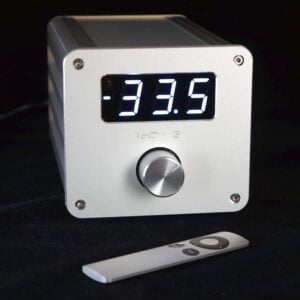
The icOn preamplifiers use custom copper autoformers built by Dave Slagle to my specification; our silver-wired versions are wound in-house. I moved to autoformers in 2019 after three years with TVC transformers, because they are simply more transparent.
Two details matter more than most people expect:
FET switches instead of relays or rotary contacts. Tap selection is done with high-quality FET switches. There are no mechanical contacts to oxidise, so switching stays noise-free indefinitely, and the signal path stays remarkably short — no rat’s nest of wiring waiting to pick up interference.
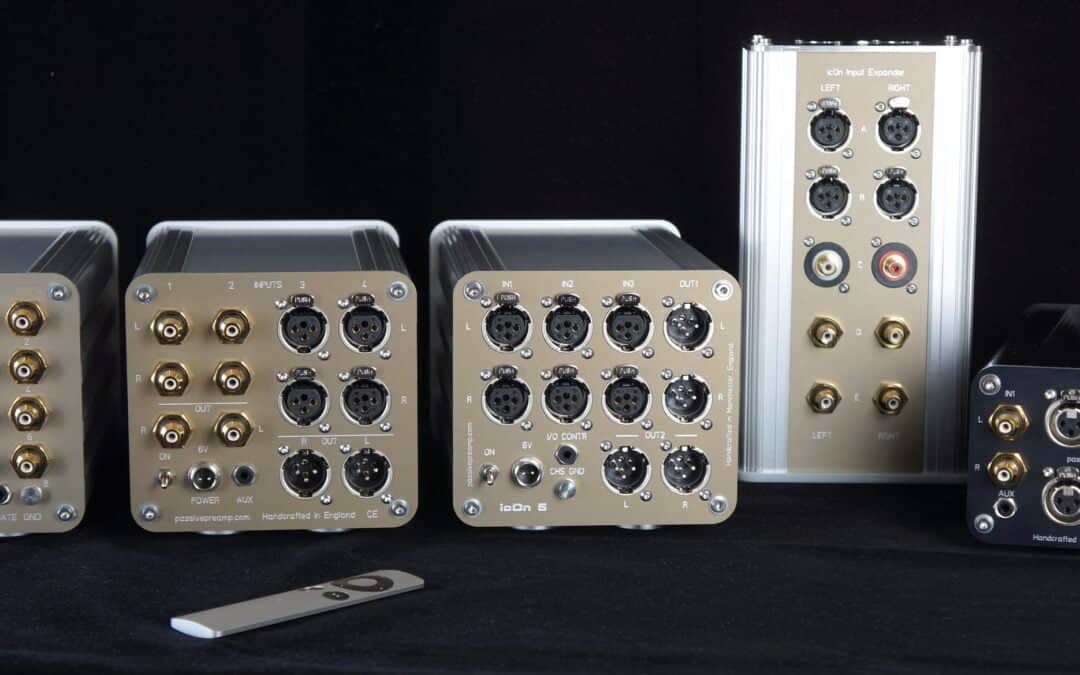
Enough steps to actually find your level. The icOn 5 gives 136 steps across an 83 dB range, from −80 dB to +3 dB, with 0.5 dB increments between −48 dB and +3 dB when the input buffer is engaged. The smaller icOn Zen offers 68 steps in 1 dB increments from +3 dB down to −63 dB. Fine steps matter more than people assume: the difference between “slightly too loud” and “slightly too quiet” is often less than 1 dB.
Everything is remote controlled from the listening seat, including balance, mute and — on single-ended icOn 5 models — a Quad-style tilt control centred on 900 Hz for gently correcting over-bright or dull recordings.
Is a passive right for you?
Ask yourself three questions. Does your source put out 2V or more? Does your power amplifier have reasonably high input impedance and normal sensitivity? Do you value transparency over added warmth?
Three yeses and a well-designed autoformer preamplifier will almost certainly outperform an active line stage costing several times more. If you are unsure, tell me what is in your system and I will tell you honestly whether it will work — including if the answer is no.
Frequently asked questions
Does a passive preamplifier reduce dynamics?
A resistive one can, through impedance mismatch. An autoformer volume control does not, because it transforms impedance rather than dividing it, and it maintains a low output impedance into the power amplifier at normal listening levels.
Do autoformer preamplifiers need burn-in?
No. Copper wire and magnetic cores do not change over a few years of use. Many customers do report an improvement after around 100 hours — my honest view is that this happens in the listener’s brain adapting to the absence of noise and distortion, not inside the preamplifier.
Will a linear power supply improve a passive preamplifier?
No. The signal path is fully passive and galvanically isolated from the internal supply circuits. The external supply feeds only the display and the microprocessor, neither of which affects the sound.
What is the difference between an AVC and a TVC?
A TVC uses a transformer with separate primary and secondary windings; an AVC uses a single tapped autoformer winding. In our testing the autoformer is more transparent and measures wider bandwidth.
Where are icOn preamplifiers made?
Every unit is designed and handbuilt by Pal Nagy in Manchester, United Kingdom, and carries a two-year warranty.
Questions about your own system? Get in touch — I answer every enquiry personally. You can also read the full technical FAQ, browse the independent reviews, or see the current icOn range.